while WE slept: USTs remain lower in wake of FOMC; #GotLongBOMBS?; bear steepening sends warning; M2 growth says ... and more FOMC recaps / victory laps
RTRS: US 30-year yield hits 2007 high, stocks attempt post-earnings recovery BBG: Bond Rout Sends Warning to Warsh That Tough Talk Is Not Enough CNBC: What a divided Fed means for investors
… AND a few thoughts …
Well THAT was some move in the curve … if I had capabilities, would likely lead with DAILY (bar) of 2s30s as 2s dropped ‘bout 4bps while long bombs up ‘bout 13bps … WOWZA.
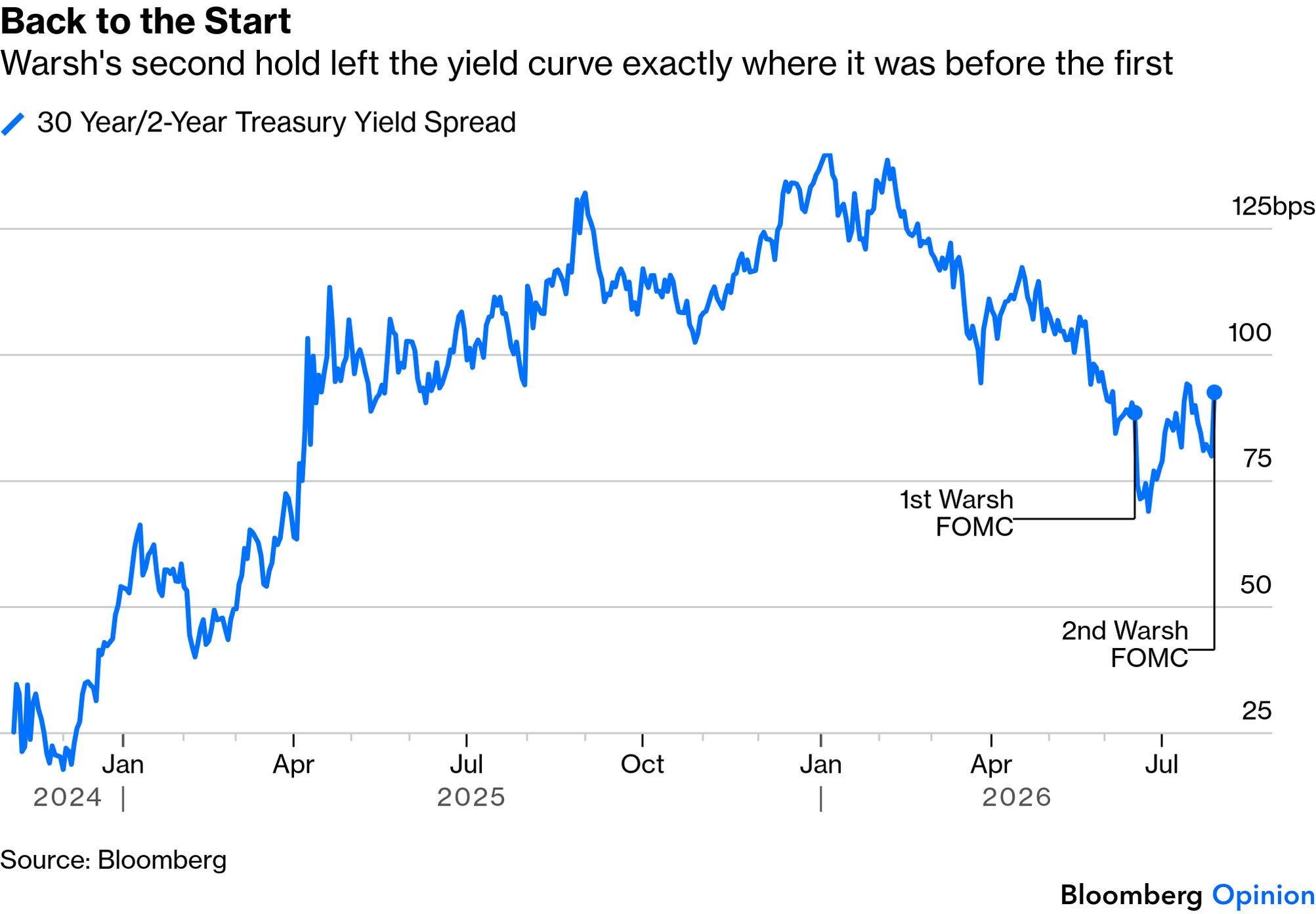
In actuality, the bear steepening that did seem quite dramatic in the moment, left the curve EXACTLY where it was before KWARSHs first meeting (evidence, context below)
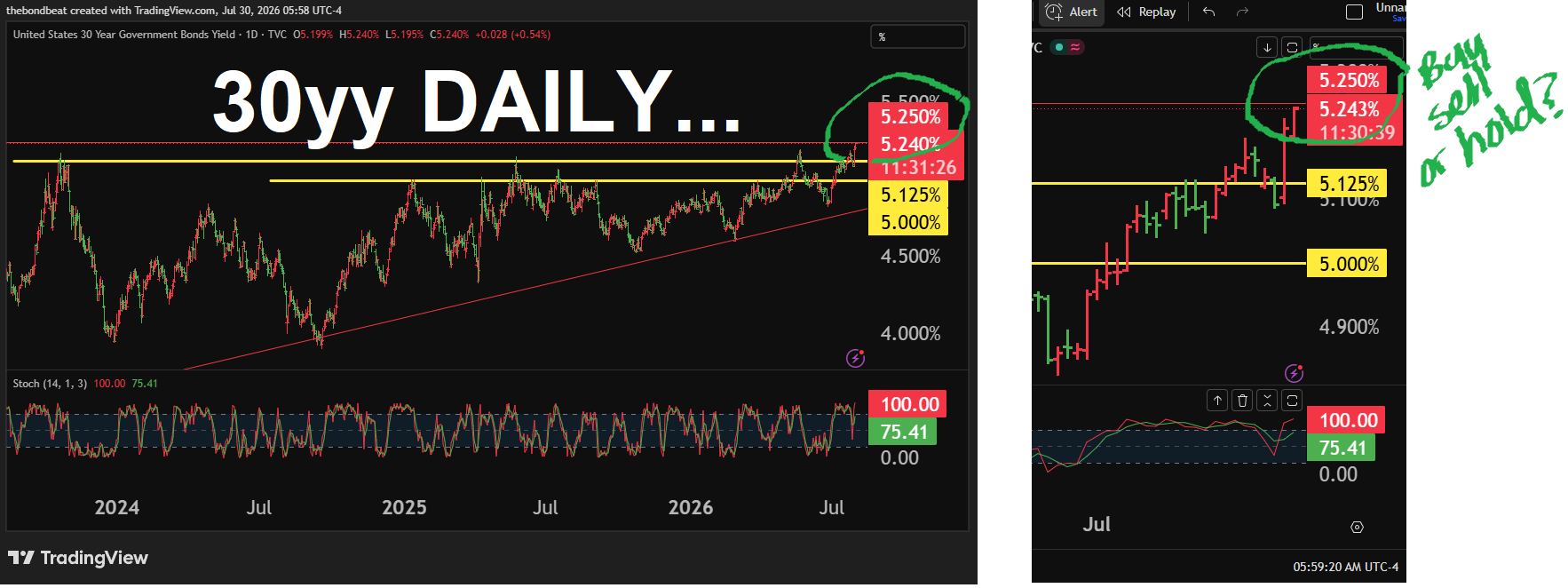
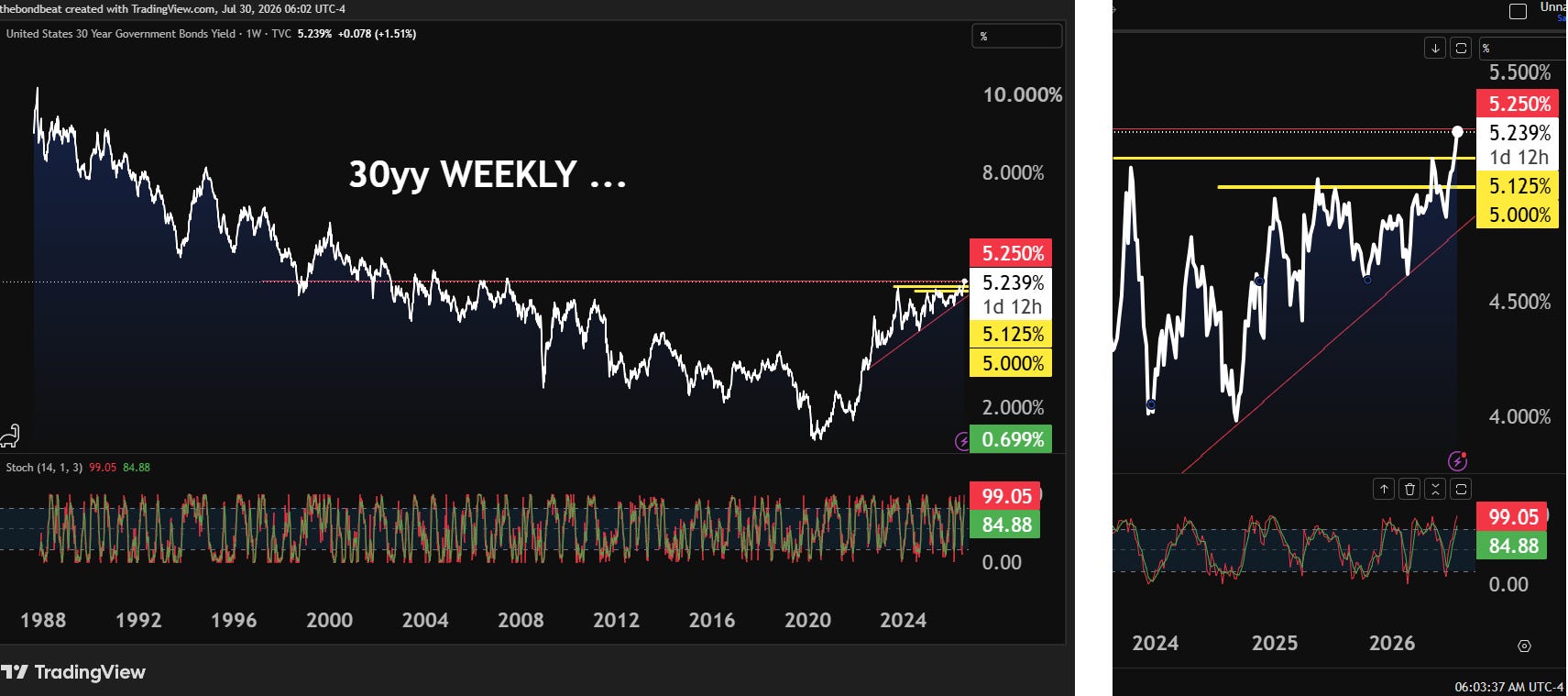
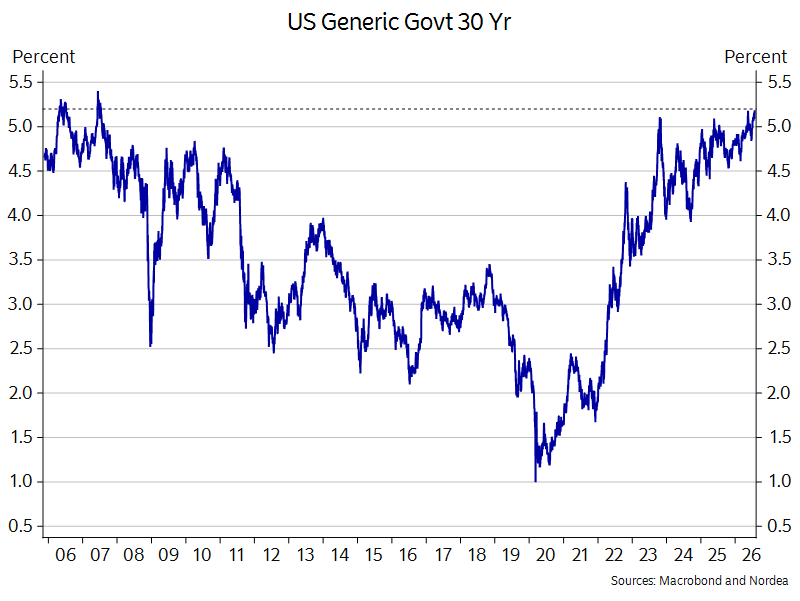
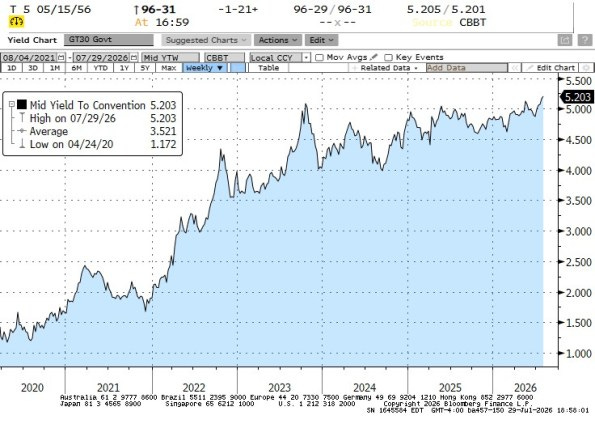
That in mind and given my current (limited)capabilities, I’ll start with a focused look at long bombs, up to levels last seen <gulp> in 2007 …
30yy DAILY (bars): 5.25% - buy, sell or HOLD here …
… is the question as yields romance 2007 highs and momentum swung back UP (and now overSOLD again …)
ZH: No Rate-Change Sparks 3 Dissents As Warsh Fed Delivers Biggest 'Non-Cut' Surprise In Decades
ZH: Watch Live: Fed Chair Warsh Explains 'Hawkish' Hold
WolfST: Fed Holds Rates after “Good Family Fight” and 3 Dissenters, after Enormous Uncertainty in the Markets - Markets were left to their own devices for the first time in a generation after Warsh scuttled forward guidance as part of his Regime Change.
WolfST: Stocks Tank, Long-Term Treasury Yields Jump after Warsh Starts Talking - “While at some level, we haven't done much in 42 days, the markets have done quite a bit”: Warsh.
…Warsh on how the bond market is already doing the heavy lifting and tightening financial conditions, now that it’s on its own without forward guidance:
“Nominal and real yields are materially higher across the Treasury curve. In fact, some of the increases in market interest rates between FOMC meetings are among the most significant in the last two decades, ranking around the top decile or so, but if the committee didn’t change its policy, what happened?
“In the intervening period, market attention centered on real data and real economic developments. Prices [of bonds] reacted in real time to incoming information, and the reduction in forward guidance may have been a factor.
“Market participants are learning to play the ball, not the referee, and market prices will continue to respond in the direction and magnitude they see fit. This is, in my view, a change for the better, and we’re just getting started…. We need to observe market reaction to developments, direct and unfiltered …
… NOT surprised of a pass. NEVER a fan of the idea you’ve got to HIKE rates to get bonds bid. Missing the interim steps of hiking rates, causing all sorts of economic pain (ie RECESSION) which THEN lowers rates…Seems to me KWARSH appreciates the bond market doing some of the heavy lifting and this would solidify an UNCH fed (see below, those who are thinking Fed UNCH through 2027) until something in the shorter-term CHANGES (ie EARL) …
To the BondBot Intern …
Headline: The Bond Market Just Sent the Fed to Detention The Fed did exactly what every betting market expected: nothing. Rates stayed unchanged. But while Kevin Warsh refused to pull the trigger, the Treasury market fired the warning shot anyway. Warsh pointed to materially higher nominal and real Treasury yields since the last meeting as evidence that financial conditions have tightened without another hike—essentially arguing that the bond market is doing some of the Fed's work. Traders immediately took the hint. The long bond sold off, the curve steepened, and equities finally remembered that higher discount rates are kryptonite. Here's the irony that never made sense in three decades on a trading desk: if inflation is the enemy, sometimes raising short rates actually lowers long rates by restoring inflation-fighting credibility. Skip the hike, and long-end investors demand a bigger inflation premium instead. That's exactly what happened. The Fed blinked. The bond market didn't. Punchline:If the Fed won't tighten policy, the term premium will gladly do it—with interest.
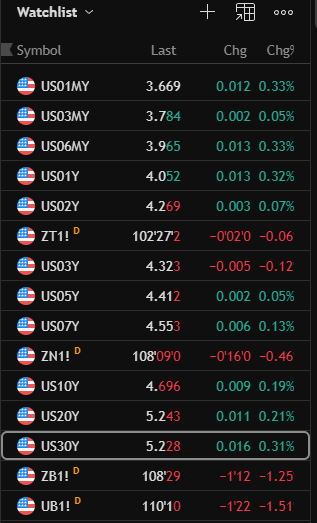
Onwards and upwards TO the reason many / most of you are likely here … whatever it may be on Global Wall’s mind but first … here is a snapshot OF USTs as of 625a:
… for somewhat MORE of the news you might be able to use … a few curated links for your dining and dancing pleasure …
Finviz (for everything else I might have overlooked …)
Moving from some of the news to some of THE VIEWS of Global Wall you might be able to use … most ALL of what follows are FOMC recaps and victory laps (?) and I TOLD YA SOs … really as many questions as answers …
Sept ON TABLE …
30 July 2026 ABN AMRO: FOMC Watch - FOMC leaves door for September hike wide open
The Fed decided to leave its target for the federal funds rate unchanged at 3.5-3.75%. This was in line with our own expectations and those of the vast majority of economists. However, few would have seen the hold as a done deal. Indeed, financial markets had priced in around a 30% chance of a 25bp hike in the run-up to the decision. In addition, three (Logan, Hammack and Kashkari) of the twelve voting FOMC members dissented, preferring instead to raise interest rates. We had expected to see some votes for hikes, though there was one more dissent than we thought there would be…
Hawk talk (dissenters) undone by dovish presser … end result is an UNCH view (and UNCH policy THRU 2027) …
The statement seemingly delivered a hawkish hold, with three FOMC voters dissenting in favor of a 25bp rate hike. But this was unwound by a dovish presser in which Warsh emphasized tightening in financial conditions that now seems inconsistent with his reluctance to react to data.
The FOMC maintained the fed funds rate target range at 3.50-3.75%, consistent with our baseline but disappointing market speculation that the committee would deliver a surprise 25bp hike to bolster anti-inflation credibility.
The statement seemed to deliver a hawkish hold, with three voters (Hammack, Kashkari, Logan) dissenting in favor of a 25bp hike, suggesting that the hold came amid resistance from those who preferred immediate hikes to waiting. Otherwise, the statement included only minimal changes, reiterating the resilience of the economy, that inflation remains elevated relative to the 2% goal, and the pledge to “deliver price stability.”
From the presser, we learned that the FOMC will still target PCE price inflation at 2% for now, and that post-meeting press conferences will continue at least through end-2026. Warsh’s comments also suggest that policy will be less tied to particular data points – such as monthly inflation prints – than Powell’s Fed, and likely less responsive to data developments more generally.
In his first two meetings, the new chairman seemed mostly focused on anchoring inflation expectations, with open mouth operations as the primary tool. He also showed little appetite for surprising markets for the sake of bolstering credibility, directly contradicting the thinking of many market participants going into the meeting.
Although he referred to the role of intensified market hiking expectations in tightening financial conditions since the June meeting, we heard little urgency to affirm these expectations if inflation remains elevated. Absent this, the market’s tightening may be a house of cards, in our view.
We retain our Fed call: We still expect the FOMC to maintain the current policy range until the end of 2027, conditional on our baseline that disinflationary pressures reemerge over the latter half of 2026. Although we continue to characterize risks to the policy path as being to the upside relative to our baseline amid an elevated likelihood of higher-than-expected inflation, we now suspect that Warsh’s FOMC might be slower to react to adverse inflation developments.
Bond market working, KWARSH patiently waiting …
July 29, 2026 BMO Close: Market Works, Warsh Waits
…The FOMC didn’t hike and while Warsh didn’t offer a great deal of information about if and when the Fed will tighten rates, the perception was that the Committee remains hawkishly disposed. In part, the hawkish skew was reinforced by Warsh’s unwavering commitment to the 2.0% inflation target. While this was to be expected, the consistency of the message is a vote of confidence for Fed independence and minimal influence from the White House. Another notable observation was that when asked why rates shouldn't be higher today, Warsh said: “So rates are higher today than they were 42 days ago. Markets have made decisions, because we stepped back in part from trying to influence those. Market judgments have moved up on what nominal rates are across the Treasury curve. That doesn't mean we take them as by dictation but we're observing them, so I think it's a mischaracterization to say that markets haven't reacted because we didn't move too. Markets are reacting in real time.” Said differently, Warsh is content to keep policy rates steady because the market is doing the heavy-lifting for the Fed. The counterpoint is that the market will only effectively tighten for the Fed for so long without seeing policy follow through from the FOMC. The Chair is skilled at communicating the dynamics underpinning the Fed’s reasoning – a distant second to outright forward guidance, but nonetheless useful as investors gauge the Fed’s updated reaction function…
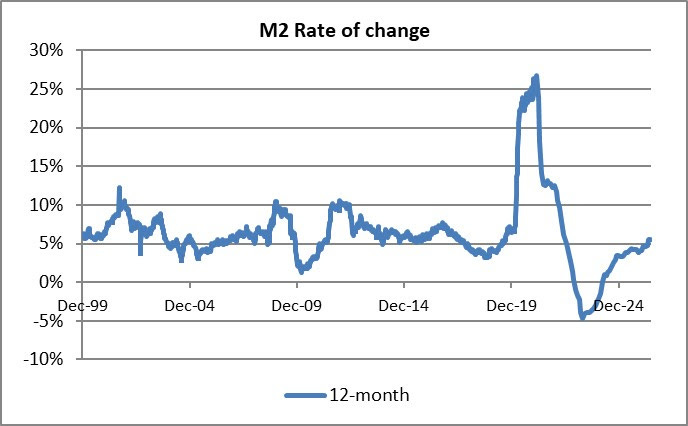
M2 growing (see below) but ‘below the historical trend pace (so, CUTS?) ?
Kevin Warsh’s second meeting as Fed Chair saw no change in rates and minimal edits to the Fed Statement, but included a press conference giving insight into what the Fed is focused on. In an economy where Warsh described output as solid, capex and productivity as strong, and the employment market as steady, he views the answer to recent inflation problems as anything but straight forward, while making clear that the Fed is on the case…
…It’s true that inflation measures remain above the Fed’s 2% target, and higher energy costs have shown in readings over recent months, but the M2 measure of money has been growing below the historical trend pace over recent years, and higher energy prices are likely to be offset by consumers eventually pulling back in other areas, which will see those other prices eventually decline. We aren’t advocating for rate cuts any time soon, but we are fully on board with the Fed asking itself hard questions while they wait for more clarity on their dual mandate. We look forward to what answers those hard questions bring…
Long end gettin’ nervous in the service …
30 July 2026 ING Rates Spark: The Fed holds and the long end gets nervous
The Fed held rates steady, and whilst 2Y rates gapped lower, the long end popped higher. Longer UST yields will remain vulnerable and the 10Y could move toward 5% again. Next in line is the Bank of England, and while we disagree with the hawkish positioning of markets, taking the opposite position remains difficult given the tight correlation with oil
29 July 2026 ING Fed holds rates steady as three FOMC members dissent
In what was seen as the closest Fed decision for a number of years, officials opted to keep monetary policy unchanged. Markets still think the Fed will tighten policy at some point, but with two inflation prints and two job reports ahead of the September FOMC meeting, nothing is guaranteed. We still think the Fed will end up holding policy steady well into 2027
…Why they could have hiked, and why they didn’t
Today’s decision was the closest call for a number of years. The rationale for a hike today can be summarised as the Fed have missed the inflation target for five years and while some progress has been made, elevated oil prices in an environment of a tight jobs market means inflation may stay higher for longer. The median dot plot from the June summary of economic projections had one hike for 2026 and with the market fully discounting a 25bp move before year-end, the question would be, why wait? Moreover, it could be seen as a statement of intent under a new Fed Chair that confirms the Fed’s commitment to price stability and helps to anchor the long end of the Treasury yield curve.
The arguments against, and why we expected a no change outcome, were that having voted to keep rates on hold in June, the data flow since then certainly didn’t strengthen the case for a hike. Consumer confidence is weak, June jobs came in at less than half what was expected with substantial downward revisions to the previous two months, and inflation data was certainly more benign than anticipated with headline prices falling 0.4% month-on-month and core inflation flat on the month. Financial conditions had tightened with the 10Y Treasury yield 15bp higher, the dollar 0.5pp stronger on a trade-weighted basis and the S&P500 1% lower with the NASDAQ down 5.5%. Nine FOMC members may well think a rate hike will be needed this year, but of those nine there is a strong suspicion that five or even six are non-voters this year. Moreover, nine others think they won’t need to raise rates and that is indeed how they voted today.
Will they hike in September?
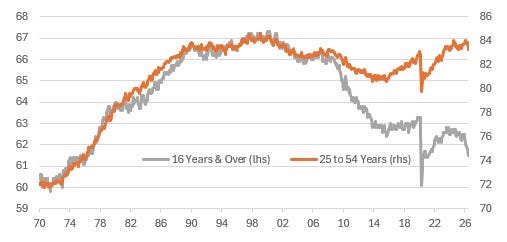
Markets ahead of today had been fully pricing a September rate hike, but again, there is a significant divergence between the market’s view and economists, who in aggregate expect stable policy to continue. We are in the camp that think the Fed will hold, but it is going to be close. Our thought process is that there are two inflation prints and two job reports between now and the 16 September FOMC meeting. Hiring surveys remain weak and there is scope for an unwind of World Cup hiring. Furthermore, the low unemployment rate has been held down by a sharp drop in the participation rate. This could indicate firms are cutting costs by encouraging early retirement. That said, even in the “prime” 25-54 age group, the participation rate has dropped 0.7pp since January. The jobs market is not as robust as the unemployment rate alone suggests.
Labour market participation rates (%)
…If we are right, and we do see further evidence of disinflation and cooler jobs data, then we expect to see the market pricing of rate hikes moderate. That could culminate in the Fed leaving the policy rate unchanged for a prolonged period rather than hiking once and then cutting again in 2027 as they are currently projecting within their summary of economic projections.
Street cred under fire … Fed HOLDS curve <bear>steepens …
Fed held rates 9-3 amid three hike dissents; oil rose on renewed geopolitical tensions; Asian tech sold off; USD weakened; EMFX gained; DXY at 100.84 (-0.6%); US 10y at 4.68 (+7.1bp).
The Fed’s decision to remain on hold reduced near-term hike pricing, but higher oil prices and concerns over inflation credibility drove a twist-steepening in Treasuries and weighed on global equities.
…US rates twist-steepened (2y: -1.5bp; 30y: +11.2bp) after the FOMC voted 9-3 to keep the policy rate at 3.5-3.75%. Three officials dissented in favor of a hike, indicating meaningful support for tighter policy even as the committee chose to wait for additional inflation and labor-market data. Front-end yields declined as investors reduced expectations for a September increase, while the long end sold off as markets demanded greater inflation and term premium. The 30y yield rose above 5.20% for the first time since 2007, and breakevens widened across the curve (2y: +8.9bp; 30y: +6.2bp). Demand at the $30bn 2y floating-rate note auction was firm, with a 3.37 bid-to-cover ratio versus 2.99 previously…
We maintain our view that the Fed will remain on hold this year. Chairman Warsh's comments imply the bar to hike may be higher than some expected. We forecast disinflation ahead, but stickier inflation is a risk to our call.
Key points
The FOMC held the target range for the funds rate unchanged at 3.50-3.75%, but with 3 dissents in favor of a hike from Reserve Bank Presidents Hammack, Kashkari, and Logan.
The Chair’s desire to take time to “understand the underlying and generalized change in prices that are happening in the economy” and “see whether we can’t separate the noise from the signal” suggests the bar for rate hikes is likely higher than markets previously thought.
We retain our outlook for no Fed hikes this year given our expectations for disinflation in coming months.If inflation remains sticky, then we think the Fed will move to rate hikes this year, perhaps as early as September, but we see potential conflict between the Chair’s reaction function and the rest of the committee.
Our rates strategists think the yield curve steepens further unless inflation comes in higher than consensus expects and Chair Warsh clarifies his press conference remarks on inflation. A steeper curve tightens financial conditions, and tighter financial conditions support a steeper yield curve. They suggest investors stay in the SFRV6 96.125/96.25 call spreads at 3.25 ticks (ref. SFRZ6 at 95.84), stay in UST 7s30s curve steepeners and SFRM7M8 curve steepeners, and remain long 2y UST-SOFR swap spreads…
…Warsh on financial conditions
Warsh was versed in speaking about financial conditions. He thought about the degree of accommodation as...
...a function both of our target fed funds rate and what the financial markets do with it, by which I don’t mean just what the expected fed funds targets are out in the future, but the transition mechanism.
He subscribed to the idea that higher Treasury yields tighten financial conditions. He spoke about term premiums and volatility (both VIX and MOVE), and looked at the T-bill market, the Treasury repo market, and the percentage of cash holdings in money market funds to see if markets were operating normally.
Warsh also spent time talking about the importance of the wealth effect...
...[an] increase of, say, 30 percent on average in asset values from spring until now might be more consequential than all of the fiscal stimulus packages in trying to help get this economy going again. And to the extent that those wealth effects are reversed, I think that’s likely to be hugely consequential…
The Fed stayed on hold but with 3 dissents. There were no new characterizations or guidance in the statement. This is in line with our view so far, and now we turn to the Press Conference.
Key takeaways
The FOMC held the target range for the funds rate unchanged at 3.50-3.75%.
There were 3 dissents in favor of hiking from Reserve Bank Presidents Logan, Hammack, and Kashkari.
Growth is still characterized as “solid” and inflation as “elevated”.
Overall, this is in line with our view that the Fed can stay on hold this year if we get the disinflation we expect.
With little new information in the statement, the attention turns to the press conf and how Chairman Warsh characterizes the data versus June, if at all.
Dissents = Sept hike (this next firms base case) remains on the proverbial table …
29 Jul, 17:17 NORDEA: Fed review: Hold now, but dissents leave a September hike on the table
The Fed held at 3.50–3.75%, but three members dissented in favour of a hike. Unlike June, this hold was not unanimous.
…Markets, for their part, drew their own conclusions. The 30-year US government bond rate climbed 10bp to its highest level since 2007, while the 2-year US government bond rate edged modestly lower. That combination is worth pausing on. The front end says markets have pared back their expectations for further hikes, despite the three dissents. But if the Fed is expected to do less now, and the long end is moving the other way, the implication is that investors are less confident inflation will be brought under control. It is too early to conclude that markets do not trust Fed to deliver. But the reaction suggests a degree of scepticism, particularly as the US dollar weakened while the 30-year US government bond rate moved higher.
With the statement essentially unchanged and Warsh giving little away, the meeting offered limited insight into the Committee’s thinking or the chair’s own. That leaves the vote as the clearest signal on offer. Three dissents, all in the same direction, tell us where this Committee is heading. We continue to look for a hike in September.
The Federal Reserve left interest rates (and the accompanying policy “statement”) unchanged yesterday. Fed Chair Warsh appeared to try and speak to several audiences. US President Trump was told inflation was the fault of the Fed but would come down. Households were told not to assume the Fed would allow higher inflation (most US households do not know the Fed’s job is to control inflation). And markets were told a lot of things.
The suggestion that the bond markets were doing the Fed’s job for it by raising real rates could be interpreted as dovish for policy. If so, bond markets took things further with a sharp selloff in long-dated bonds. This may not all be inflation expectations—uncertainty risk must be adding to real yields, with economic consequences…
29 July 2026 US Economic Perspectives FOMC: on hold & looking for signals
Chairman Warsh: "The Fed is on the case" The Federal Open Market Committee voted 9-3 to leave the target range for the federal funds rate unchanged at the July meeting, in line with our expectations. Also in line with our base case, FRB of Cleveland President Beth Hammack, FRB of Minneapolis President Neel Kashkari, and FRB of Dallas President Lorie Logan voted in favor of raising rates by 0.25 pp.
In a wide ranging press conference, Chairman Warsh avoided providing much clarity on the path ahead, or even what was behind today's decision. He did again reiterate the FOMC's commitment to deliver price stability. The message was delivered with determined language…
…Among the more substantive things he seemed to say was that treasury yields were doing some of the work for the FOMC. He wandered around the topic of what to infer from market pricing, something he seems to be on a bit of a quest for, to purge the "hall of mirrors" problem. He mentioned "financial conditions" at one point. Several exchanges mentioned market pricing can sometimes lack signal because it is being pushed around by Fed guidance. What signal he would take, he refrained to say. We would note that Governor Waller influenced market pricing with his speech this month, pointing to the CPI. How one purges markets from Fed commentary with 12 regional Fed Presidents speaking publicly and frequently is not quite clear. That sounds like following the other FOMC participants too. Overall, Warsh seemed to take the market moves in between meetings as support for remaining on hold and not hiking.
The June press conference left us with the sense that every meeting is a live meeting, and this press conference reiterated that too. Chairman Warsh seemed to allude to the incoming data that the FOMC would know in the inter-meeting period. He did not emphasize anything, quite the opposite, but in two exchanges indicated they would know more in September. He also said he would consult with the task forces. There is an element of wondering whether a policy decision might await the task force results, but that is unclear…
…Conclusion As we keep saying, this is a learning process. Chairman Warsh delivered determined words on restoring price stability, but appears to be weighing AI's disinflationary potential, and whether price pressures might broaden or narrow from here. Some better inflation news and/ or some softer labor market data in our view would keep the FOMC on hold again in September.
In our assessment, the policy decision today was Chairman Warsh's to decide, as we explained in our preview last week: "FOMC: Decision time". In that sense, we learned a little more today about how he is weighing information and the input from his colleagues. Taking it all in, he decided to leave the policy rate unchanged. While his press conference did not deliver perfect clarity, he appears to be looking at a range of data, including market prices, financial conditions, inflation expectations, and economic data. We will see what that brings in the next six to seven weeks before the September FOMC meeting.
29 July 2026 UBS: US Rates Strategy "Play the ball"
The FOMC held rates unchanged in a 9–3 vote. Warsh rejected idea of passive "pause." Today's 2pm developments were in line with our forecast, while Chair Warsh’s remarks suggested less urgency to tighten despite keeping September in play. Warsh highlighted the unusually large increase in nominal and real yields across the Treasury curve during the 42 days since the prior meeting.
The Treasury curve bear steepened sharply, ending 15bp steeper end-to-end. Front-end yields fell 2bp and long-end yields rose 13.5bp; 30-year real yields reached 3%. Markets now price about a 16% probability of a September hike and 50bp of cumulative tightening by June 2027, though SOFR options continue to signal upside risk to that path.
Markets price about a 16% probability of a September hike…
We maintain our forecast for no further hikes this year…
Don't fade the sell-off in long-end yields just yet. Long-end weakness appears driven primarily by rising term premium amid reduced Fed guidance, greater structural rate volatility, and persistent duration-supply concerns; we remain cautious about fading the move and retain long 10Yx20Y inflation swaps…
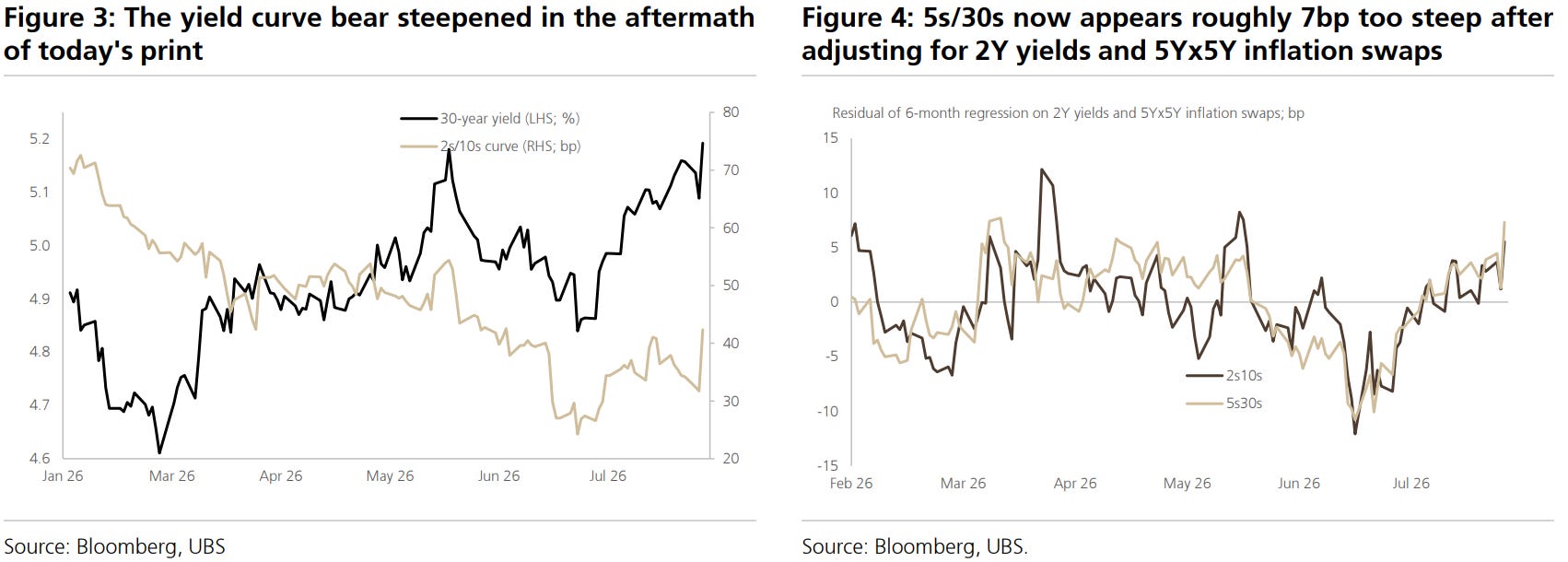
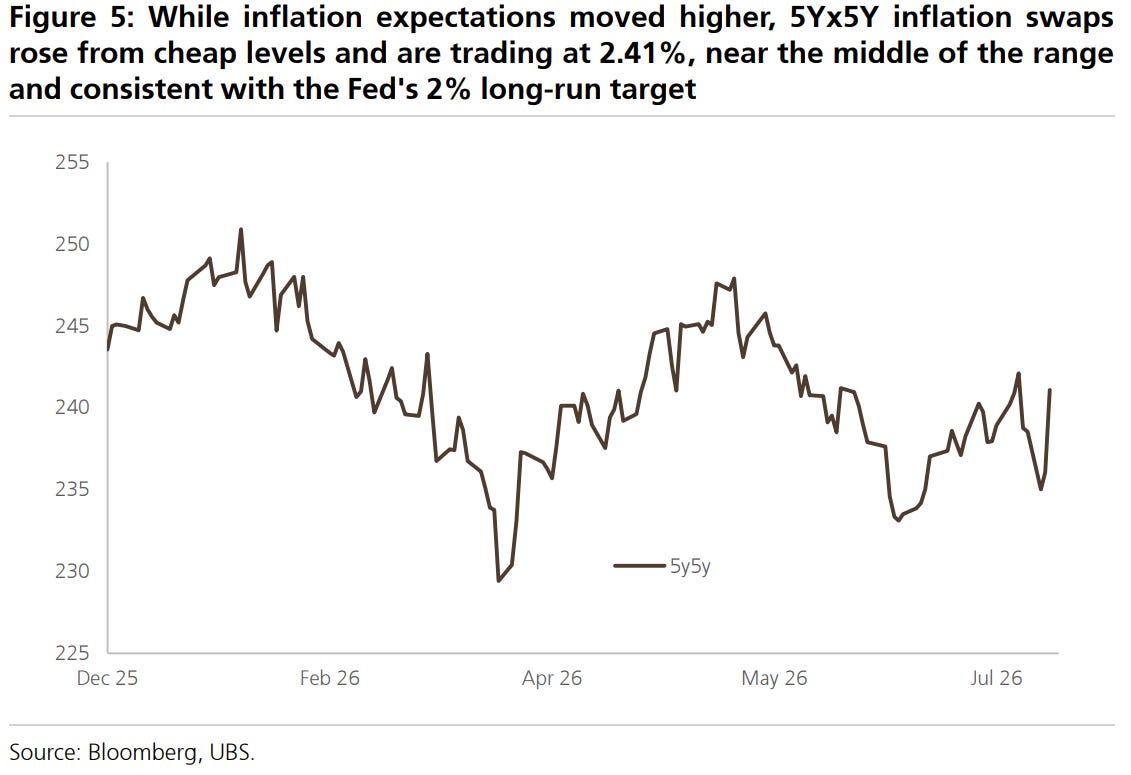
…Meanwhile, the move at the long end of the curve was significant, especially as the market priced in a more dovish Fed path at the front end of the curve (Figure 3The yildcurve bastpned ihafterm oday'sprint). The jump in longer-run inflation expectations in the aftermath of the meeting does justify some steepening in the curve, but the 5s/30s curve now appears roughly 7bp too steep based on a 6-month regression versus 2-year yields and 5Yx5Y inflation expectations (Figure 45s/30 nowapers oughly7bp toseafr djusting for2Yyields an5Yxiflaton swp). Notably, while inflation expectations moved higher, 5Yx5Y inflation swaps rose from cheap levels -- near the lowest of their YTD range -- and are trading at 2.41%, near the middle of the range and consistent with the Fed's 2% long-run PCE inflation target (given a CPI-PCE wedge that has averaged near ~30bp historically) (Figure 5).
More importantly, we think the sell-off at the long end primarily reflects a continued rise in term premium, which is at least partially justified by the removal of forward guidance, reduction of transparency in Fed communications, and the implications for higher structural rate volatility. This structural change is coming at a time when duration supply remains top of mind for investors. While we expect Treasury to retain its forward guidance next week, signaling unchanged auction sizes for at least the next several quarters, we recently revised our budget deficit forecasts higher, and we see the supply of Treasuries in 10-year equivalents rising materially in 2028. Meanwhile, though duration supply in the form of Treasury issuance has remained stable this year, IG issuance has picked up materially, driven primarily by the tech sector, with 32% of YTD hyperscaler supply coming with maturities of 10-years or longer (see here). Our credit analysts forecast $1.9tn of overall IG issuance in 2026, with $450bn coming from Tech. Against this backdrop, we are hesitant to fade the long-end move just yet, even as valuations are appearing quite cheap. In inflation markets, TIPS breakevens widened 6- 9bp across the curve, outperforming carry and energy by 6-7bp. We continue to see the most value at the long end of the curve and maintain longs in 10Yx20Y inflation swaps (see here).
WHEN not if from former MS strategerist …
Published July 29, 2026 WisdomTree Fed Watch: Is It a Matter of When, Not If? Kevin Flanagan Head of Investment and Fixed Income Strategy
The Fed kept rates unchanged at today’s meeting, but markets are increasingly focused on the prospect of future hikes. Kevin Flanagan explains why the next move may be a matter of when, not if, and what investors should watch in the months ahead.
Key Takeaways
Markets are now pricing a September rate hike and a total of at least two increases by next spring, suggesting investors should prepare for a Fed that has shifted from easing toward a more hawkish, data-dependent stance.
Chairman Warsh’s focus on price stability and “no tolerance” for inflation suggests resilient labor markets and incoming inflation data will determine whether the Fed begins reversing last year’s rate cuts.
Rather than the start of a new tightening cycle, the more likely outcome is a measured reversal of some of last year’s rate cuts, making the Jackson Hole conference an important event for fixed income investors watching for policy clues.
…The Bottom Line Our base case scenario continues to see a somewhat patient approach to the decision-making process, with the Fed ‘on hold’ going forward. However, the leash is on the shorter side with monetary policy now tilted toward a rate hike as the next move. While Warsh has de-emphasized forward guidance, the money and bond markets will still be looking to the annual August Jackson Hole Fed conference for clues as to what the Chairman is thinking.
Finally, Bond Vigilantes suggest they need MORE than hawk squawks ..
Jul 29, 2026 Yardeni: Warsh Fails First Credibility Test: Bond Vigilantes Want More Than Hawkish Squawks
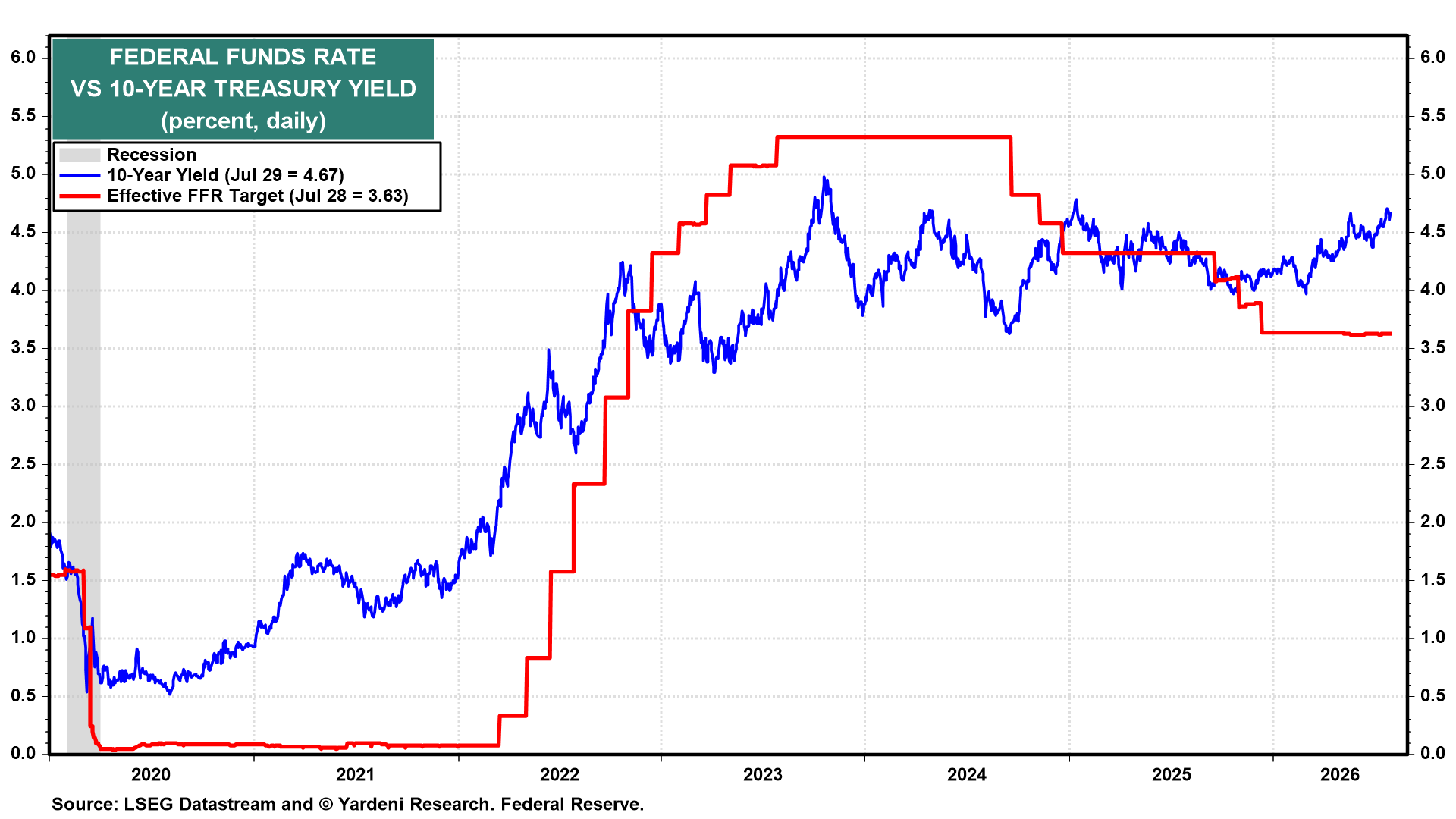
Fed officials just won’t listen to us! We warned them that the economy didn’t need the four cuts in the federal funds rate (FFR) at the end of 2024. The Bond Vigilantes agreed with us and pushed the 10-year Treasury bond yield up by 100bps at the time (chart). The same happened late last year. The Fed lowered the FFR three times. The bond yield drifted higher and continued to do so this year.
We correctly anticipated that the FOMC would pivot from its dovish stance in April to a hawkish stance in June. Then we predicted that the committee would follow up with a rate hike in July. They didn’t listen to us. Once again, the Bond Vigilantes are pushing bond yields higher. In effect, they are saying that if the Fed won’t be vigilant about inflation, then they will have to maintain law and order in the economy.
Under the circumstances, we conclude that the Fed has to raise short-term rates to lower long-term rates. Talking hawkish but not acting so reduces the Fed’s credibility.
At the FOMC meeting today, the committee voted 9-3 to leave the federal funds rate (FFR) unchanged at 3.50%-3.75%. Beth Hammack, Neel Kashkari, and Lorie Logan dissented, each preferring a 25bp hike. Fed Chair Kevin Warsh struck an unambiguously hawkish tone at today’s press conference. He emphasized (again) that the economy remains resilient and inflation is still above target. He reiterated that restoring price stability is the Fed’s top priority. Indeed, the FOMC statement closed with the same reassuring pledge as last month: “The Committee will deliver price stability.”
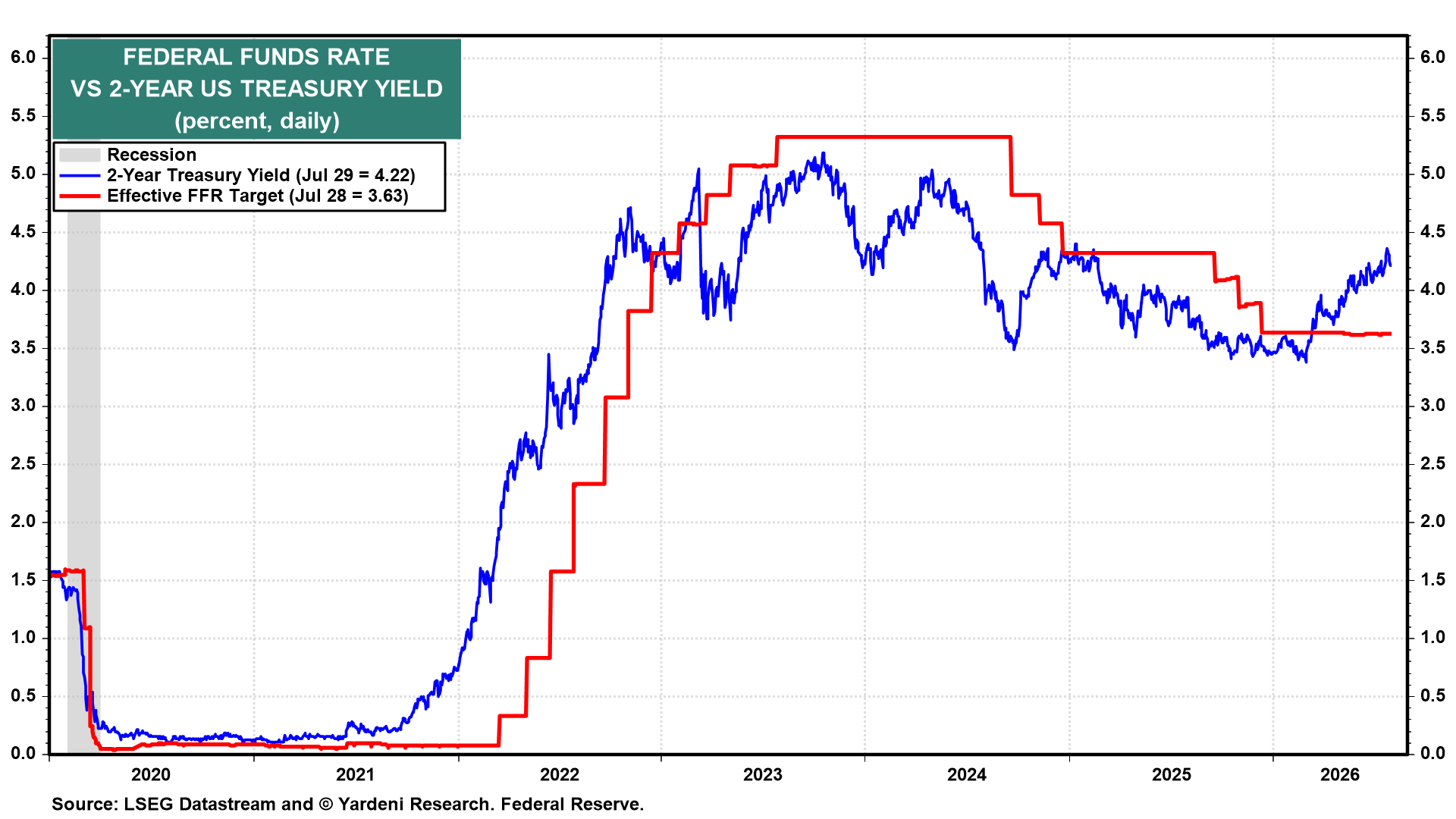
Delivering price stability is exactly what the Bond Vigilantes want the Fed to do. Ahead of the meeting, the 2-year Treasury yield traded roughly 75bps above the federal funds rate, indicating that the Fed should reverse last year’s FFR cuts that were billed as insurance policies to protect the labor market from weakening. At the time, inflation seemed to be heading closer to the Fed’s 2.0% target.
… Moving along TO a few other curated links from the intertubes. I HOPE you’ll find them as funTERtaining (dare I say useful) as I do … …
AI keeps lid on wages NOT job growth …
July 30, 2026 Apollo: AI Lowers Wages But Doesn’t Cut Jobs
Analysis of actual Claude usage data shows workers in AI-exposed occupations are experiencing slower wage growth, while employment levels in these occupations remain unchanged, suggesting companies are capturing AI productivity gains through wage compression rather than workforce reduction.
This paper was written by Sania Edlich and me using a difference-in-differences methodology with occupation and year fixed effects across 321 matched occupations from 2015 to today. The paper is available here.
All VIEWS created equally and some more equal than others. Here’s one such view and I happen to agree (this morning) …
July 30, 2026 at 4:24 AM UTC BBG: Warsh needs to do better than ‘I won’t tell you’ Any more questions?
…By common consent, the gold standard for an uncommunicative interview belongs to the late Dr. Hastings Banda, for decades the president of Malawi. In 1962, when the campaign for independence from Britain was at its height, he gave a one-minute interview to the BBC in which he answered nearly every question with a version of: “I won’t tell you that.”
Kevin Warsh’s performance during his 45-minute press conference on Wednesday was far more charming. But his bottom line was much the same, and the market wasn’t buying it. Warsh is actually considering doing away with press conferences — a policy that Banda would probably have approved — and it might have saved everyone some time if he’d cut the niceties and simply done a Banda.
Paradoxically, his second outing as chair of the Federal Open Market Committee should have been a non-event. Rates didn’t change. Neither did the accompanying official statement. There were no dot plots or projections, and Warsh ducked questions about future intentions and reaction functions.
Yet a non-event it was not. Markets rewarded him with the sharpest steepening of the yield curve in a year, and a late selloff for stocks that brought the Nasdaq 100 more than 10% below its peak. Explaining quite what happened and why is tricky.
The statement was short enough to reprint in full. It was also essentially unchanged from the last meeting in June. I’ve marked the only alteration, which did nothing more than update a tense:
The Committee decided to maintain the target range for the federal funds rate at 3-1/2 to 3-3/4 percent, in support of the Federal Reserve’s dual mandate. The Committee iscontinuing [reaffirmed] its policy of maintaining ample reserves in the banking system. Economic activity is expanding at a solid pace despite elevated uncertainty that owes, in part, to the conflict in the Middle East. Productivity growth and capital investment are strong. Job gains have kept pace with the workforce, and the unemployment rate has changed little. Inflation remains elevated relative to the Committee’s 2 percent goal, in part reflecting supply shocks that have driven price increases in certain sectors, including energy. The Committee will deliver price stability.
It’s been an eventful six weeks, with the oil price falling and then resurging as the Middle East conflict spun out of control again, while both inflation and employment data in the US were surprisingly moderate. None of this merited a change to the statement.
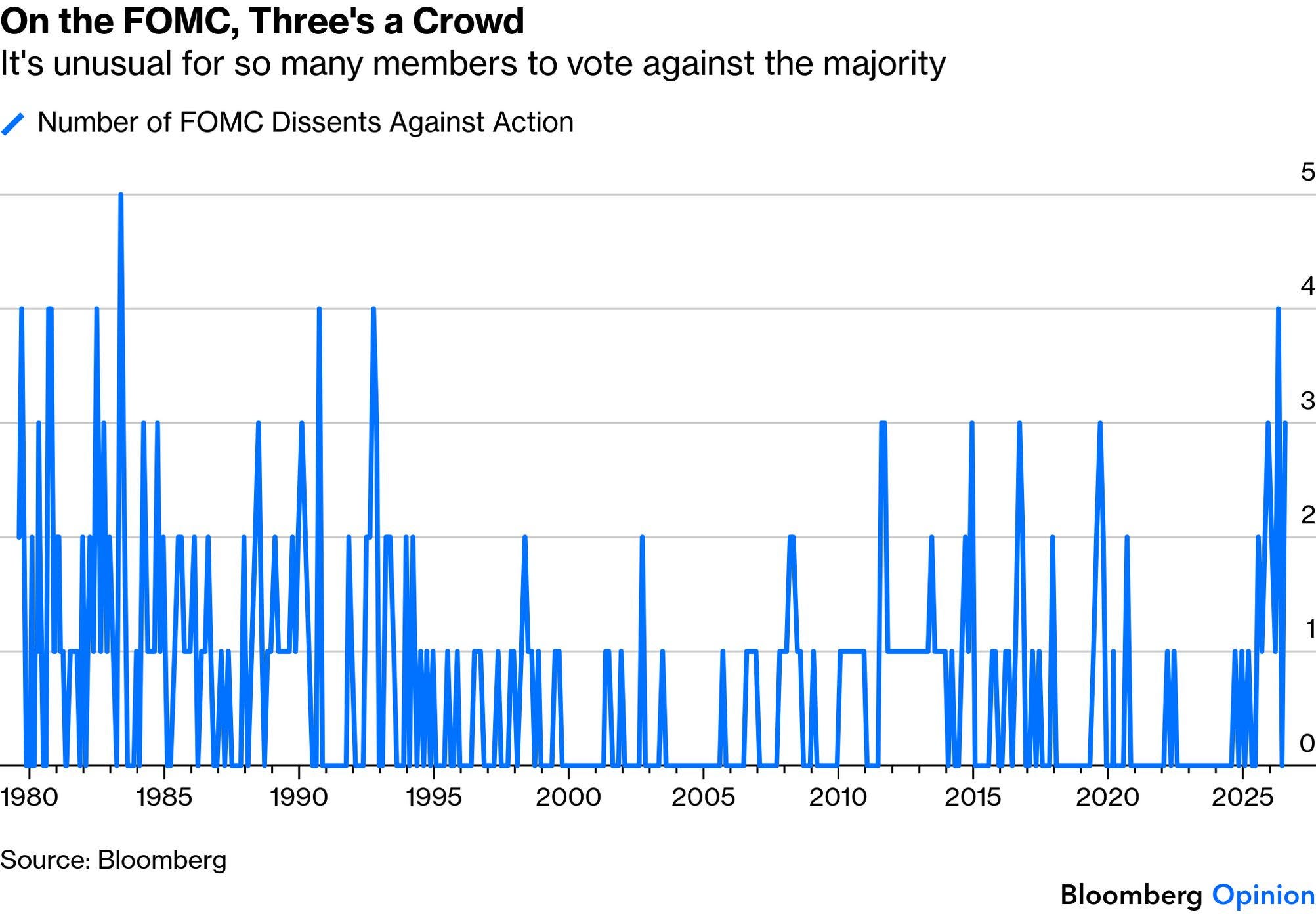
But even though inflation dropped between the meetings, three governors of regional Feds voted to hike rates this time, against unanimity in June to stay on hold. That was only the sixth time in the last 30 years that as many as three FOMC members dissented:
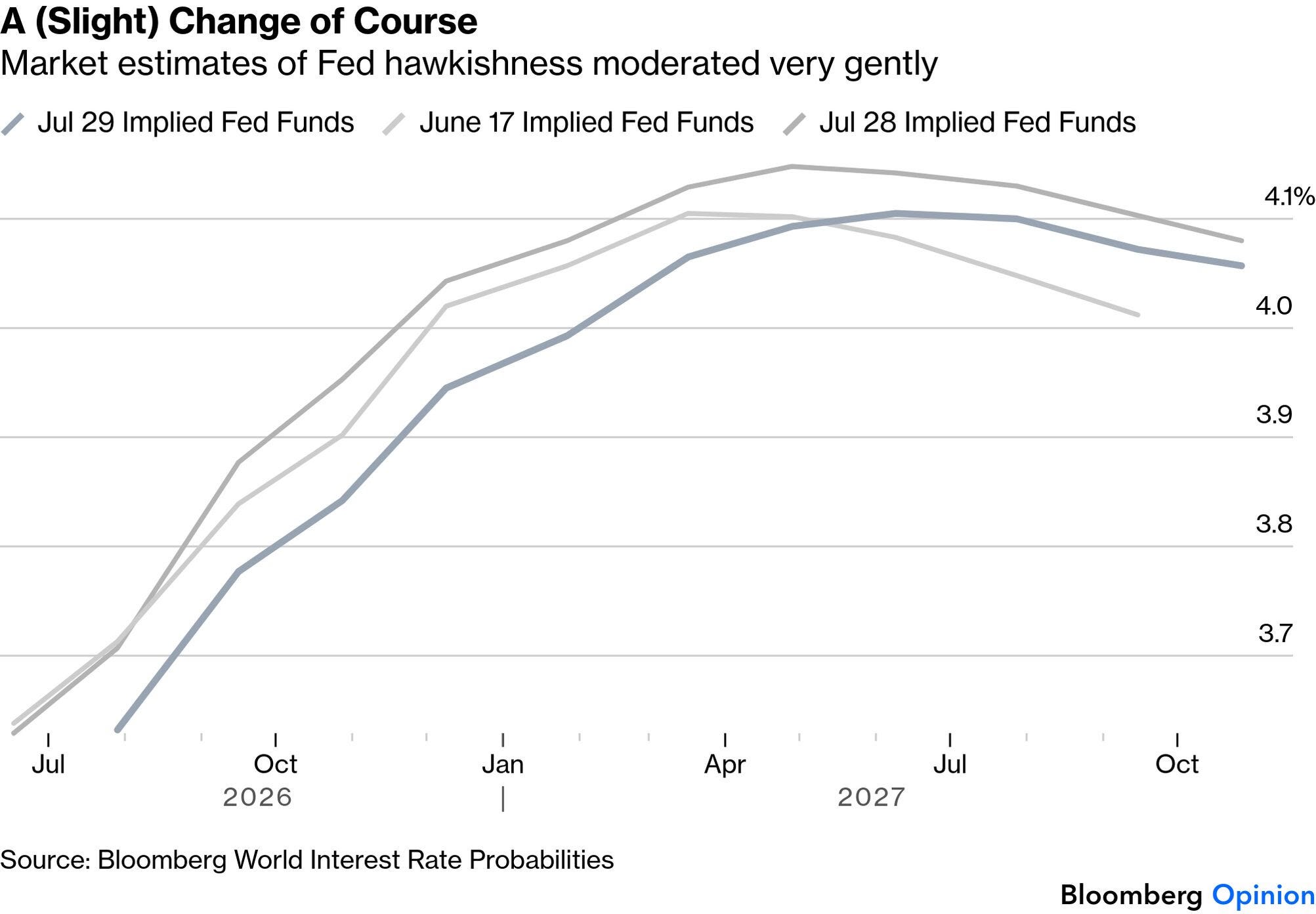
Despite the statement of intent, fed funds futures responded by trimming back their implicit course for the future. There had been a non-trivial chance of a hike, and that dominated the action. But overall, it’s noticeable that the market’s projections really haven’t changed much so far under Warsh:
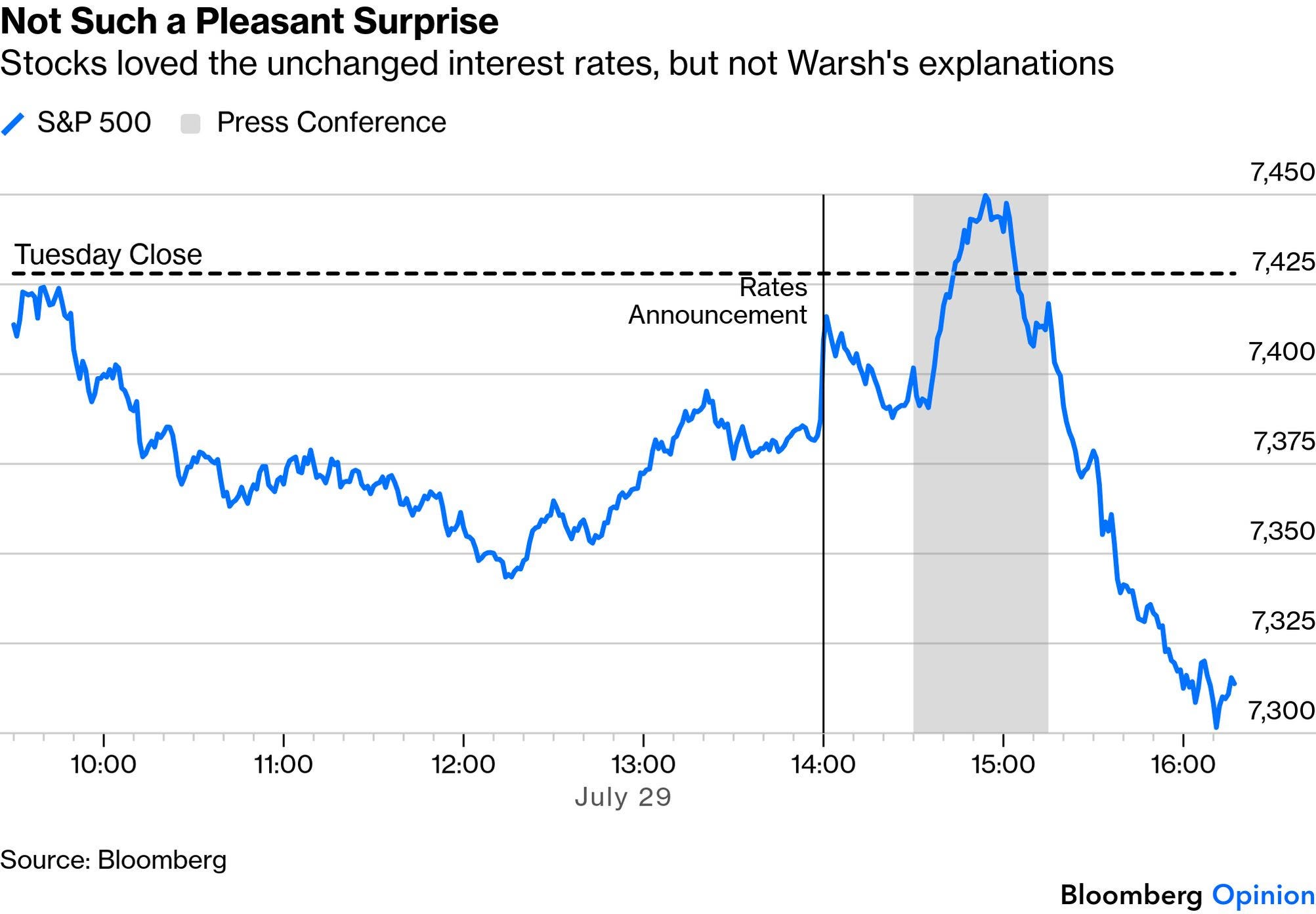
Then came the press conference. There, Warsh could explain the dissents, justify the decision to overrule them, and reassert his hawkish credentials. He did none of these. Warsh is known to favor doing away with press conferences altogether, and was expected to speak somewhat opaquely, as Alan Greenspan used to do. The stock market’s reaction showed the Banda approach didn’t go down well:
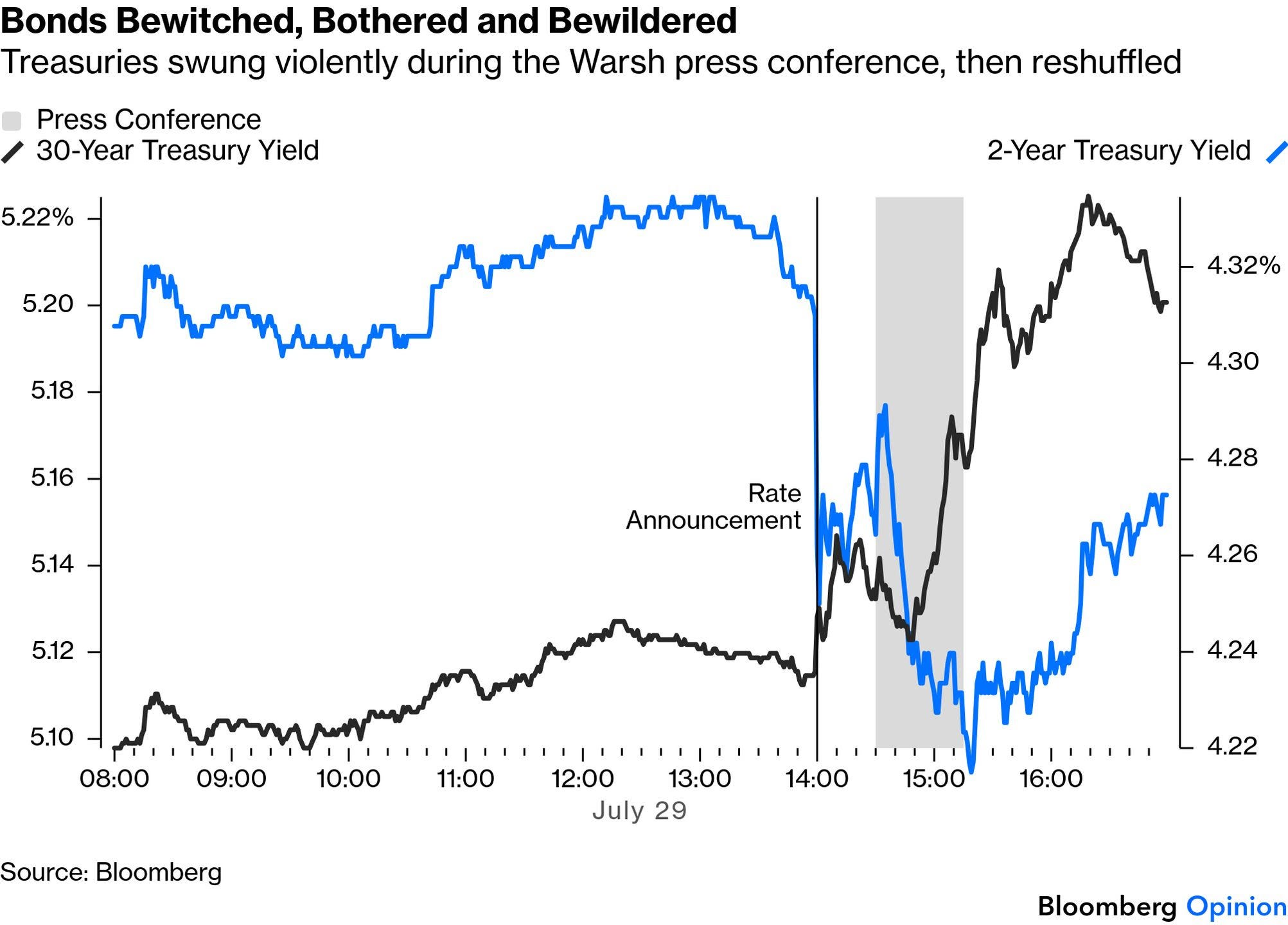
Stocks found the performance unconvincing, and retreated from initial glee that a hike had been avoided. The critical verdict came from bonds. You wouldn’t guess Warsh had said almost nothing from the way bond yields moved as he was speaking:
The fall in the two-year yield suggests that traders think he revealed himself as a dove. The rise in the 30-year yield, which touched its highest since 2007, shows traders think this will prove to be a mistake, bringing higher inflation and forcing the Fed to hike more in the longer term. That’s quite a vote of no-confidence. The predominant emotion was confusion, plain and simple, as both ends of the yield curve retraced a lot of their moves after the conference ended.
What went wrong? Those dissents can best be interpreted as the governors registering their belief that rates were going to go up at this meeting, in line with the hawkish stance Warsh had outlined in June. If you’re going to be a hawk, at some point you need to bare your talons and pounce. The dissenters — in line, apparently, with the market — didn’t find complete inactivity this month to be credible.
Some of the few things Warsh did say were “starkly dovish,” according to Bank of America’s Aditya Bhave:
First, he opened the door for looking at other inflation indicators besides PCE. Second, he suggested there could be other tools besides hikes to fight inflation. Third, he implied that markets have done some of the Fed’s tightening work for it.
His repeated World Cup invocation that the markets tightening rates since the last meeting had been “playing the ball, not the referee” also missed target. Incoming data on oil, inflation and employment might all have been expected to push yields lower. The rise was helped by hawkish comments from Warsh’s colleagues, led by governor Chris Waller — traders had very much been watching the referees.
The whole episode is like an advertisement for the benefits of forward guidance. Withdrawing it made a drama out of what should have been a non-event. Dario Perkins of TS Lombard commented that trying to make monetary policy boring and taking the Fed off the front page had “achieved the exact opposite”:
So far, Kevin Warsh has talked a good game. In fact, talking seems to be his greatest talent. He denied that the Fed has a “revealed preference” for >2% inflation, contradicting the facts of the last five years, but he then spent the entire 45 minutes offering what can only be described as “spin” on how the economy was performing. There was nothing of any substance, like a bad novel told by an unreliable narrator. Maybe it would be a good idea to scrap these press conferences after all.
The net result is that it will grow much harder to resist a hike next time, just to offer belated proof of his hawkish bona fides. The hardcore Banda approach might have worked better. The yield curve is back exactly where it was when Warsh took over in late May:
One rule of central banking is confirmed. When a new chair arrives at the Fed, the market tests them. Inevitably, they make a mistake that investors leap on. Jerome Powell said he could reduce the balance sheet “on autopilot”; Ben Bernanke thought he could kvetch to Maria Bartiromo off the record; and now Warsh believes he needn’t explain why he wasn’t raising rates when inflation was too high. Powell and Bernanke lived and learned. Warsh must do the same…
A visual, and a lesson learned over time and throughout history …
Jul 29, 2026, 8:56 PM DATATREK: Warsh Vs Recession/Inflation History, Fund Flows
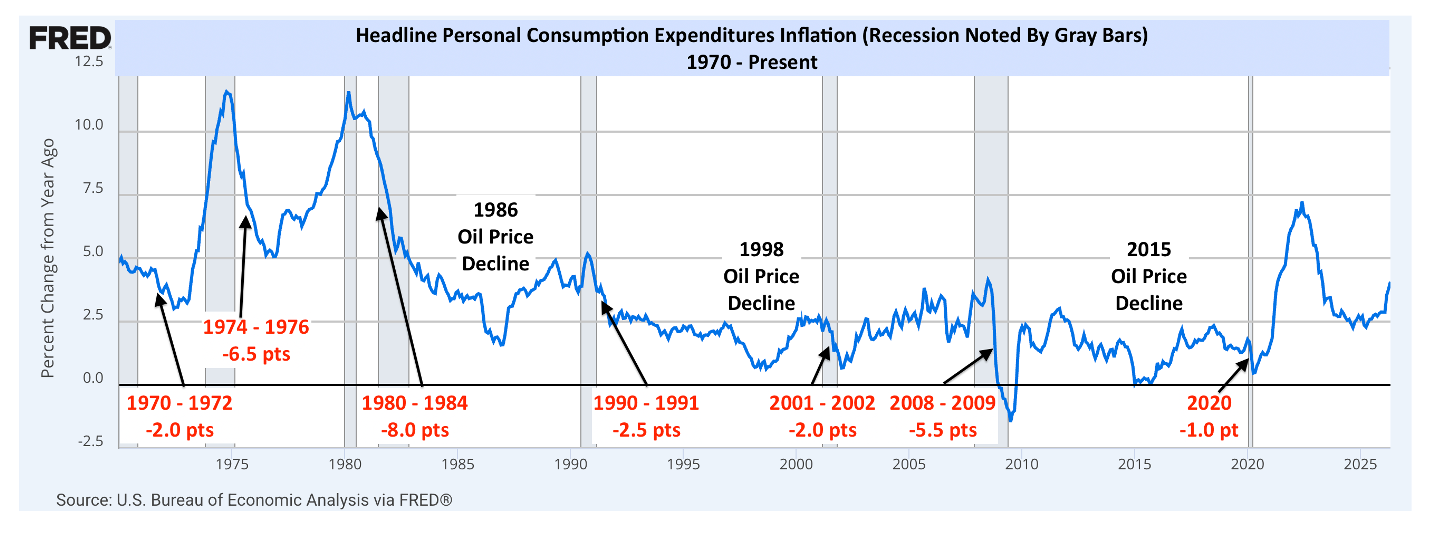
…Topic #1: At his post-meeting press conference, Chair Warsh said he strongly believes that the Fed can achieve its 2 percent inflation target without damaging the US economy, so let’s look at some history. The following chart shows Personal Consumption Expenditures inflation (headline PCE, the Fed’s benchmark) from 1970 to the present:
Three points on this data:
Recessions (noted by the gray bars) always reduce inflation. The effects vary based on starting points, the magnitude of the contraction, and timespan in between economic slowdowns. In the 1970s/early 1980s, inflation was very high (+8 percent) but came down quickly during and after recession. The 2007 – 2009 Great Recession caused outright deflation. Even the 2-month Pandemic Recession in 2020 hit inflation for a full point.
The only other macro factor that reduces structural inflation is a sudden drop in oil prices. We noted three such instances in the graph: 1986 (oil down -50 percent), 1998 (-35 pct), and 2015 (-58 pct).
These observations put current inflation readings into their proper context. PCE inflation was +4.1 percent in May and is expected to be +3.7 pct in June. Oil prices are high and rising. There has been no recession since early 2020. Of course inflation is above the Fed’s target …
Takeaway: Markets know this history and its lessons. Perhaps this time will be different, and a Warsh Fed can engineer a soft landing even as it slows the US economy to reduce inflationary pressures. But the onus is very much on the Fed to prove it can do so. Perhaps an end to Mideast tensions and lower oil prices can help but, outside of that, the historical record shows that reducing inflation from current levels usually requires a recession.
Topic #2: Today’s market reaction to the FOMC decision to stand pat and Chair Warsh’s press conference, starting with changes in US Treasury yields:
Two-year yields fell -1 basis point, to 4.27 percent
Ten-year yields increased by +8 basis points, to 4.69 percent
Thirty-year yields rose 7 basis points, to a new 1-year high of 5.21 percent
Comment: To our eyes, these moves are not consistent with the market saying the Fed is behind the curve on tackling inflation, but rather that investors are shortening the duration of their portfolios in response to incremental volatility at the long end of the curve. The Fed has executed a hard pivot under Warsh, from speaking freely and often to barely communicating at all. That incremental uncertainty compounds at longer maturities, increasing term premium. A steeper yield curve is the natural result.
Moving on to Fed Funds Futures expectations for FOMC policy decisions at its last three meetings this year:
September 16th:
Futures put 63 percent odds on a 25 basis point hike at the next FOMC meeting, up from 56 pct yesterday.
The probability the Fed stands pat is now 37 percent, up from 24 pct yesterday.
Yes, the market was giving 20 pct odds of two sequential 25 basis point hikes before today’s meeting. Now, the probability of what would be a 50 basis point hike in September is zero.
October 28th meeting:
In keeping with the market’s general view that the Fed will not alter monetary policy just days ahead of US midterm elections, the odds that rates will be 25 basis points higher than today are about the same as those for September (53 pct).
The possibility of rates being 50 basis points higher (i.e., a second sequential hike) is now 17 pct, down from 31 pct yesterday.
The odds of no rate hikes between now and the end of this meeting increased today, to 27 from 17 pct.
December 9th:
Futures give the highest odds (44 percent, up from 36 pct yesterday) for Fed Funds to end the year 25 basis points higher than today.
The second most likely scenario is two 25 bps rate hikes (33 pct, down from 36 pct yesterday).
Takeaway: Short term yields barely moved today, and expectations for near term Fed hikes actually moderated, but long-term yields rose. At his press conference, Chair Warsh said the Fed watches the US Treasury market very closely for signals about the state of the US economy and the expected path of policy rates. He will likely take today’s price action as a sign the Fed is on the right track. Long term bond investors may not feel the same way…
CHARTS … another one on the 20yr (TLT, BROKE 83.10 … ) …
Raise rates to bring (long bomb)rates down cuz, you know … credability … GARBAGE and someone else thinks so, too …
July 29, 2026 E-piphany: Multiple Poppycock Warning on Warsh Fed Meeting #1
People are worried about rising interest rates at the long end of the curve. “The Fed should raise interest rates,” they say, “to bring interest rates down.”
Just a quick rationality check there: read the sentence a couple of times.
I know you’ve been told that long interest rates go down when the Fed has ‘credibility,’ and they can only have credibility if they raise rates. That’s double-poppycock. First, because when the Fed raises interest rates, interest rates go up even at the long end of the curve. Don’t believe me? Here’s the 30-year bond yield, plotted against the Fed funds rate. I want you to find for me the place where the Fed tightened and yields fell. Go ahead, I’ll wait.
Now, I’m not saying that yields never go down when the Fed is hiking, or vice versa. It’s just very rare. And yields move around for lots of reasons, so sometimes Fed funds and long yields move in the opposite direction for spurious reasons. But it is super clear that the main driver of long interest rates is short interest rates…
…Now, having said all of that…there are currently some bad signs for inflation that the Fed should address by shrinking the balance sheet as quickly as they can. It was disheartening to head Chairman Warsh utter the poppycock (just one) about the system needing ‘ample reserves.’ The system did just fine for generations when the Fed had an extremely skinny balance sheet. The bigger problem now is that interest rates have risen enough that even if the Fed sold all of the bonds in the portfolio, it couldn’t drain nearly as much as they added by buying those bonds back when they were goosing things in 2020.
But here is the thing that I don’t hear people talking about, at least in the context of inflation and monetary policy:
The economy is just not slowing down very much…maybe it is just beginning to?…despite tighter financial conditions from higher interest rates and a supply shock from higher energy prices. Yeah, the 30y bond is at 5.2%. Where is that having an impact on growth? Higher rates mean less cash-out refinancing to help sustain consumption, a greater propensity to save (which is after all why market interest rates rise, to induce savings because other sources of dollars aren’t keeping up with the demand for dollars), and a stronger dollar which weakens foreign demand for our goods. Higher energy prices are, to be sure, a zero-sum game financially when we are mostly self-sufficient in energy, but historically higher energy prices have slowed ex-energy growth.
The fact that this isn’t happening, and that equities are not appreciably declining despite higher interest rates, is concerning because it suggests – to me at least – that there is too much liquidity in the system. M2 is rising at 5.5% y/y, and that’s too fast in the current environment (as I’ve pointed out before). It’s rising at a 7.2% annualized rate over the last 6 months.
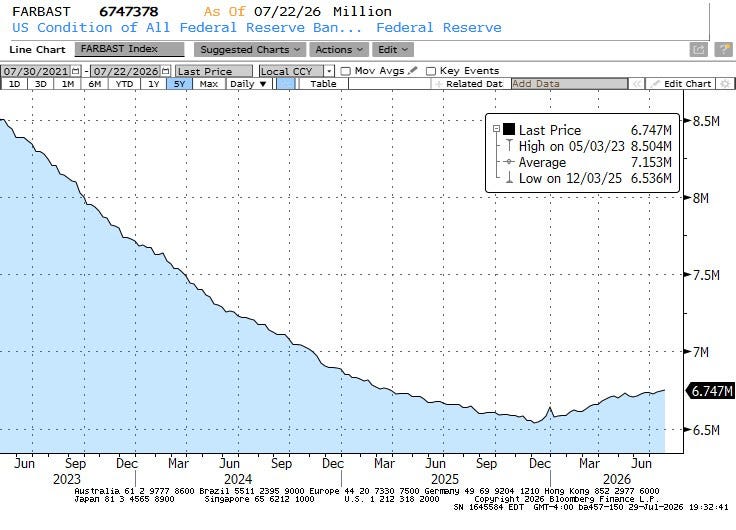
And that’s happening partly because the Fed has been growing the balance sheet, not shrinking it.
It doesn’t feel like that is enough to explain the bulletproof economy, so it may be that there’s shadow liquidity from (for example) the growth of stablecoins. Now, economic growth is not a bad thing in itself, and growth doesn’t cause inflation. But if the amount of money growth is accelerating, and the benefit from holding non-cash balances is increasing (tending to raise velocity), and that’s enough to keep the economy pushing right through an energy shock and the higher cost of money…then to me that says it’s going to be hard to keep it from leaking into prices. The Fed does not need to hike rates – that would only make things worse. The Fed needs to take stern action on the balance sheet, though, and soon.